Wholesale and distribution
Distribution software for wholesalers and dealers, built into your ERP.
Agree prices per customer, approve orders before they ship, let customers order for themselves, and run vans and field visits that reconcile to the last unit and the last rupee.
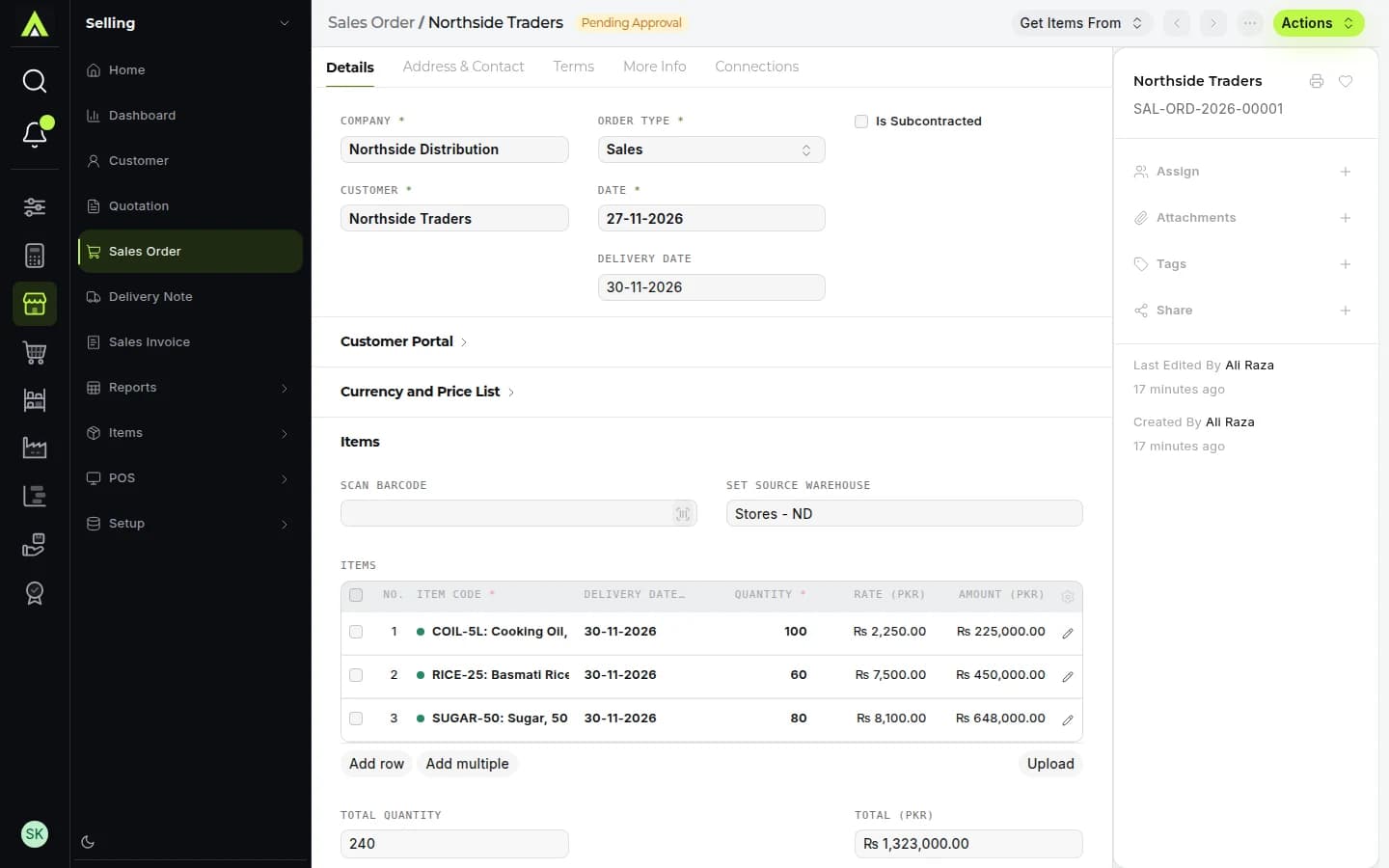
Stock, money and customers stay in the same records as the rest of AlpineERP. Nothing is exported or synced.
Who it is for
Built for companies that buy, stock and sell in volume.
For food and beverage, FMCG, pharmaceutical, electronics, building materials and general merchandise.
Wholesalers
Sell by the carton and the pallet to shops, with each customer's own price and credit limit.
Distributors and dealers
Run routes, vans and delivery rounds across a territory of regular customers.
Importers
Buy abroad, add freight and customs to the cost of the goods, and know what stock really cost.
Trading companies
Quote, approve, deliver and invoice with the controls a trading desk needs.
Customer pricing
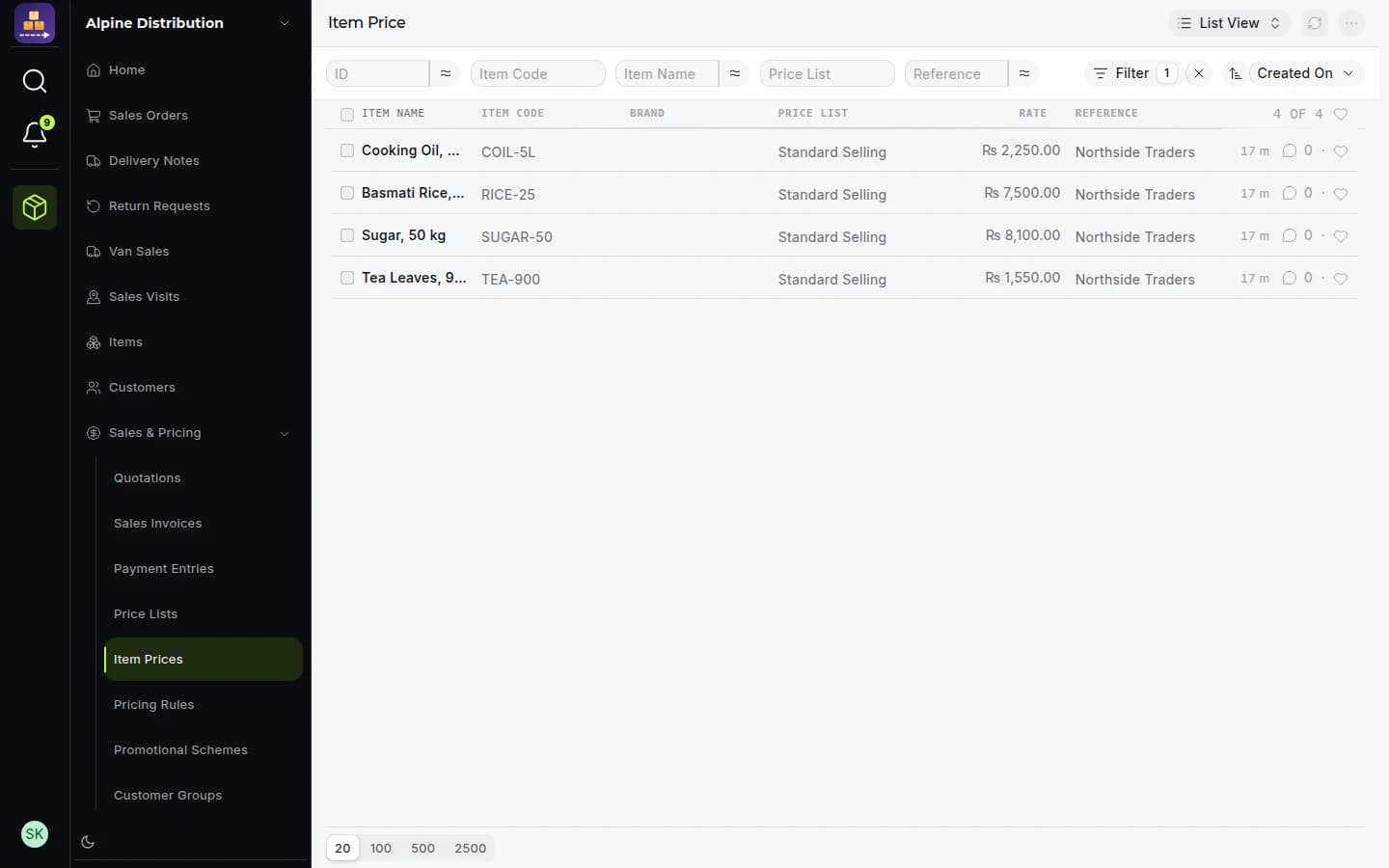
Each customer pays their own price, every time.
Agree a price with a customer once. It applies to every order, whether your team raises it or the customer places it from the portal. The price is worked out on the server, so both always match.
- Customer-specific prices with start and end dates
- Volume and customer-group pricing
- Free-goods offers, such as buy 10 and get 1
- A negotiated price is never discounted a second time
- Expired or future-dated prices are ignored automatically
- Prices convert to the order's currency and unit of measure
Approval and credit
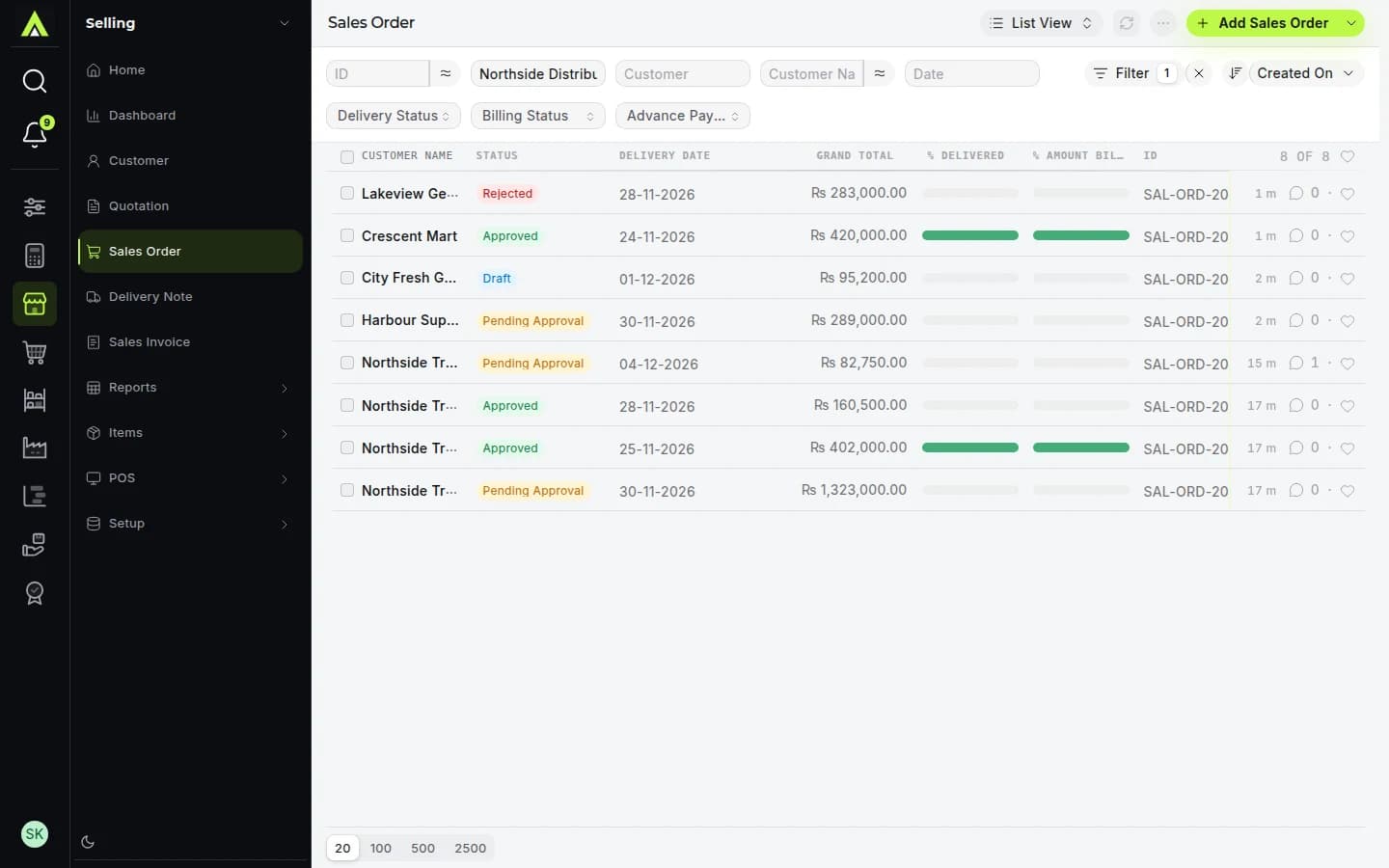
Every order is approved before it ships.
Orders follow a fixed approval flow. The system will not let an order go through without it, and credit limits are checked when the order is submitted.
- 1
Raised
A sales user creates the order, or a customer places it on the portal.
- 2
Reviewed
A sales manager approves or rejects it. Rejection records a reason.
- 3
Credit checked
The customer's credit limit is checked on submit.
- 4
Released
The approved order moves on to delivery and invoicing.
- Draft, pending approval, approved or rejected
- Sales users raise orders, sales managers approve them
- Self-approval is blocked
- An order over the credit limit is stopped; a credit controller can override
- Orders placed on the portal arrive already waiting for approval
- A rejected order can be reopened as a draft
Customer portal
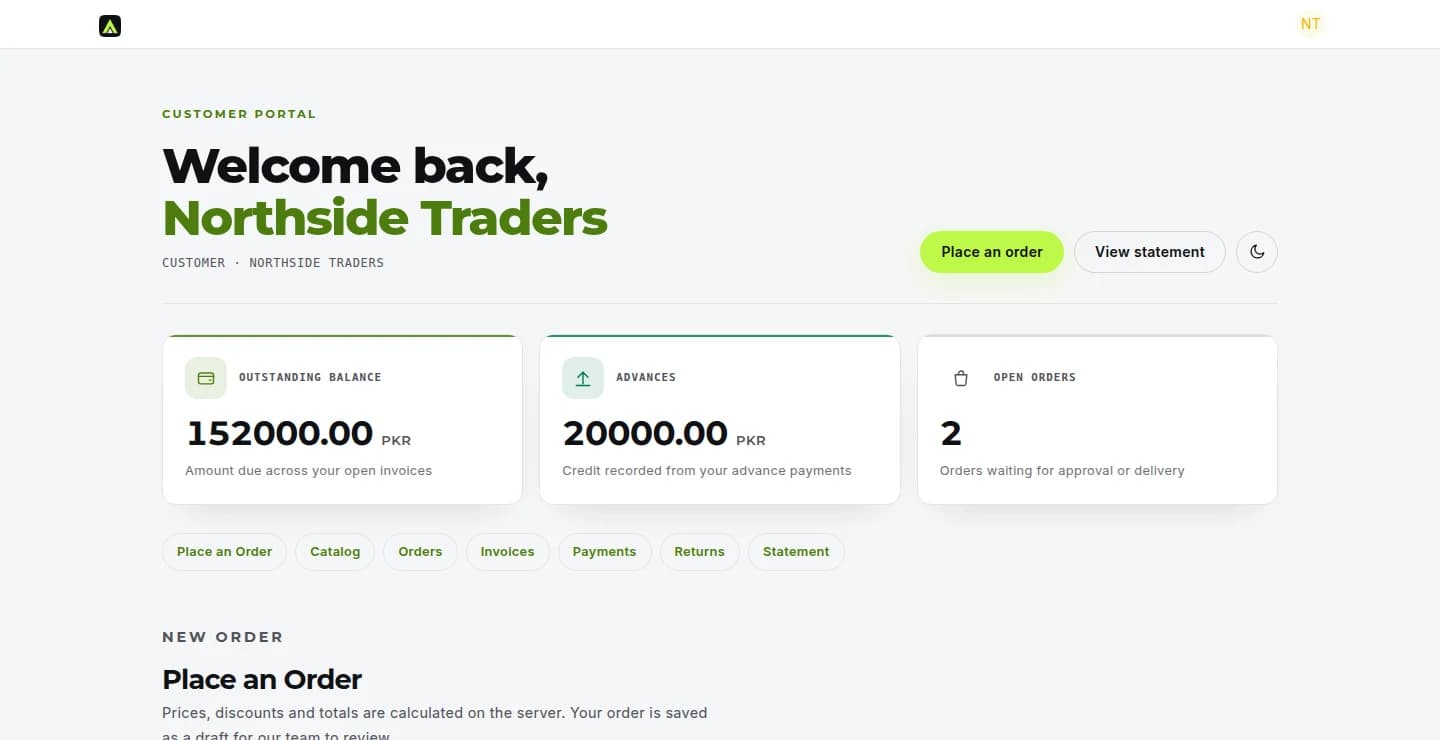
A portal where customers place their own orders.
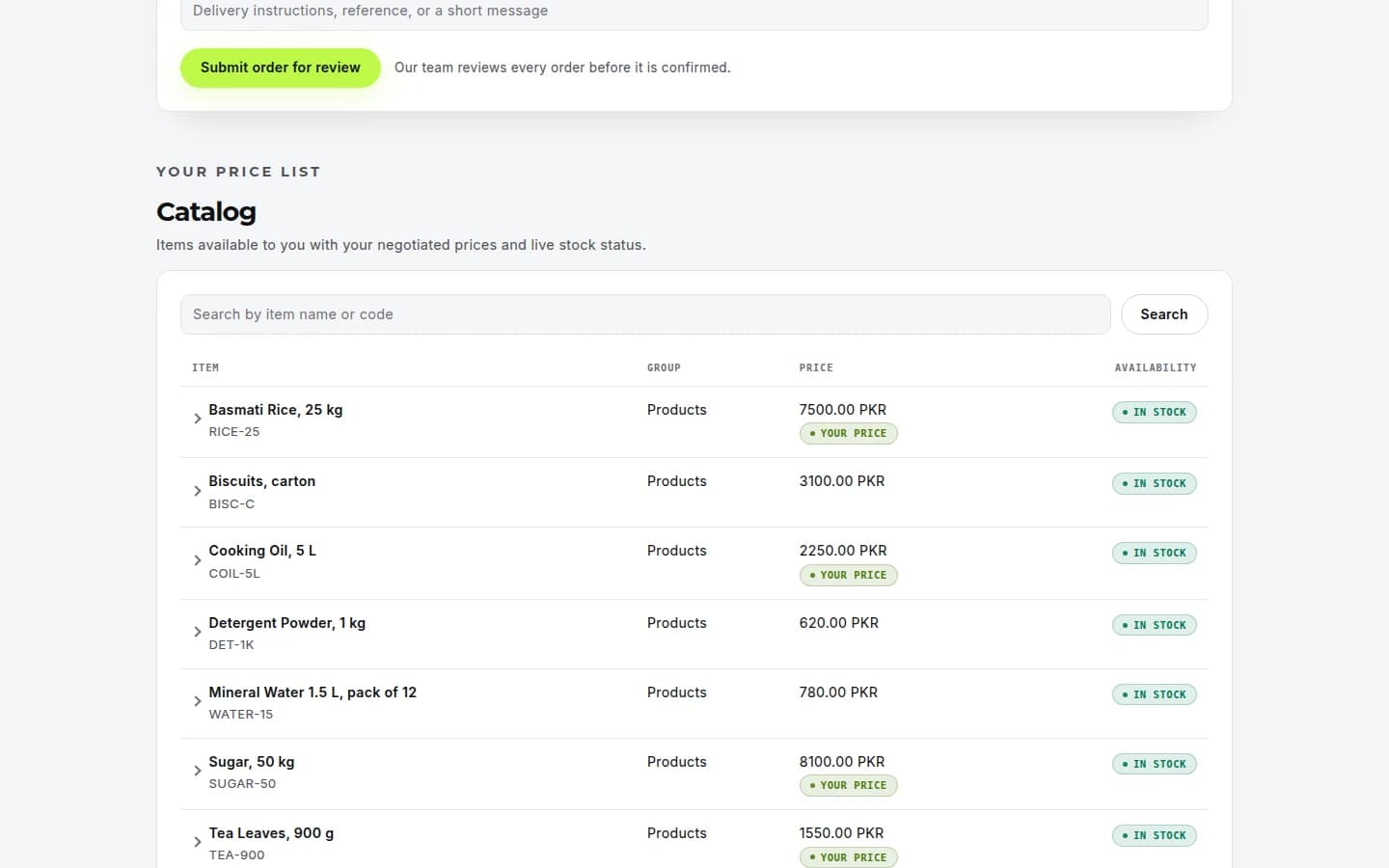
Customers sign in to a private page. They see their own prices and whether an item is in stock, place orders and follow them, without calling your team.
- A catalogue with the customer's own prices
- In stock or out of stock, never your quantities
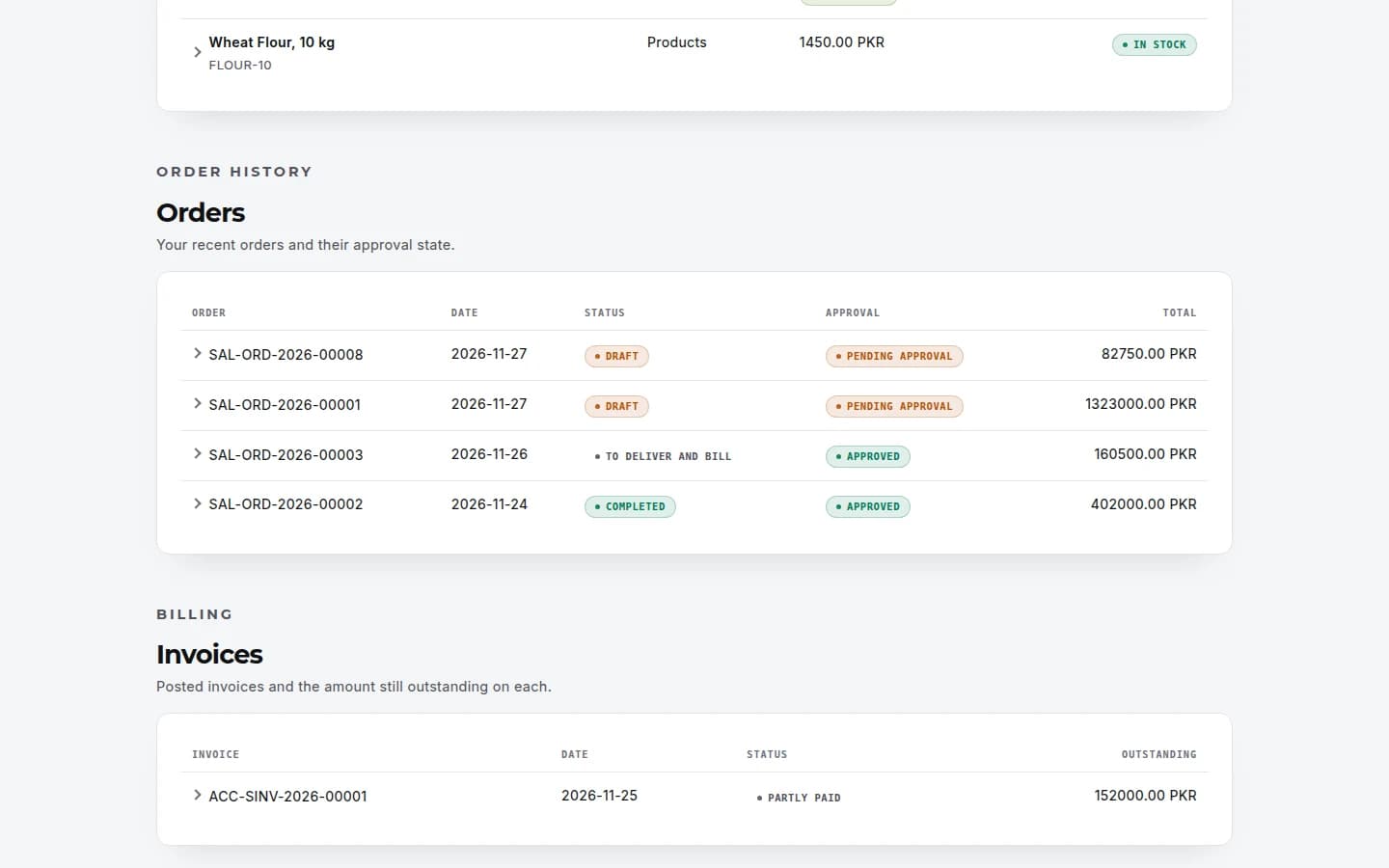
- Orders priced again on the server, then sent for approval
- Order history and approval status
- Invoices, payments, advances and balance
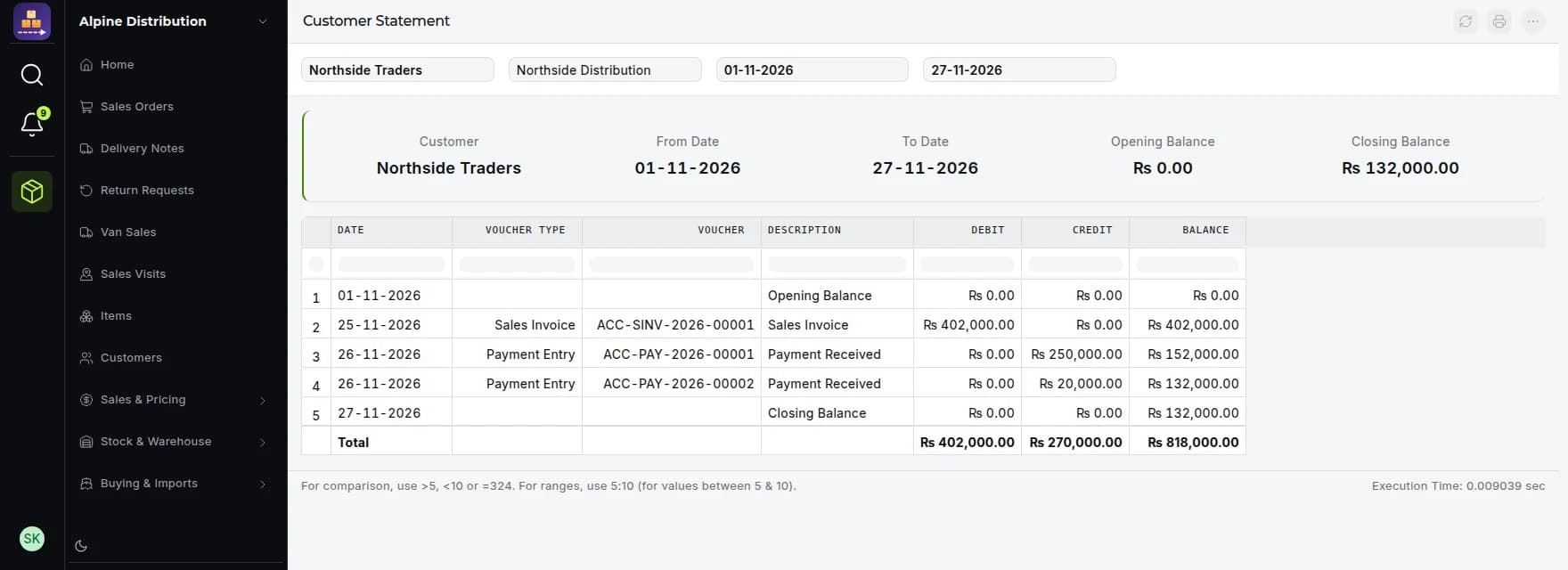
- A statement for any date range
- Return requests against their own deliveries and invoices
- Works on a phone, in light or dark
Each customer sees only their own records. Access is tied to one customer account on the server, not to anything in the browser.
Field sales and delivery
Plan the round, visit the shop, prove the delivery.
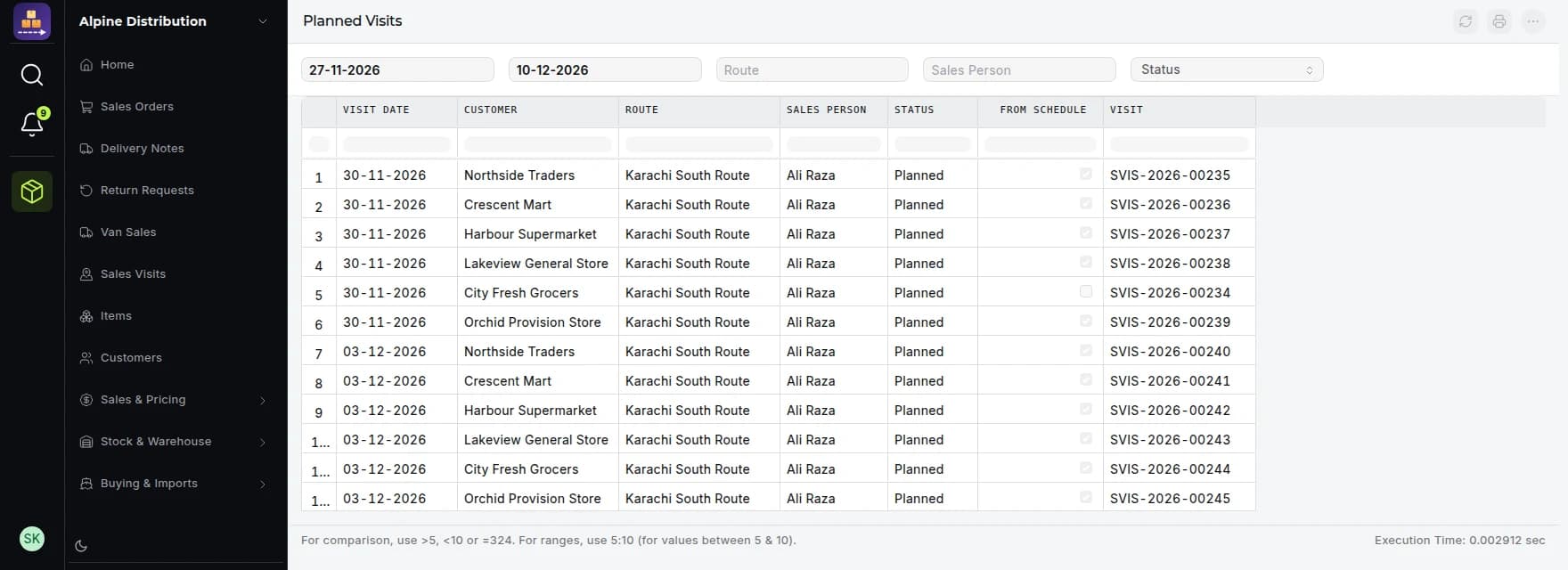
Routes, visits and deliveries are planned by the system and recorded from the road.
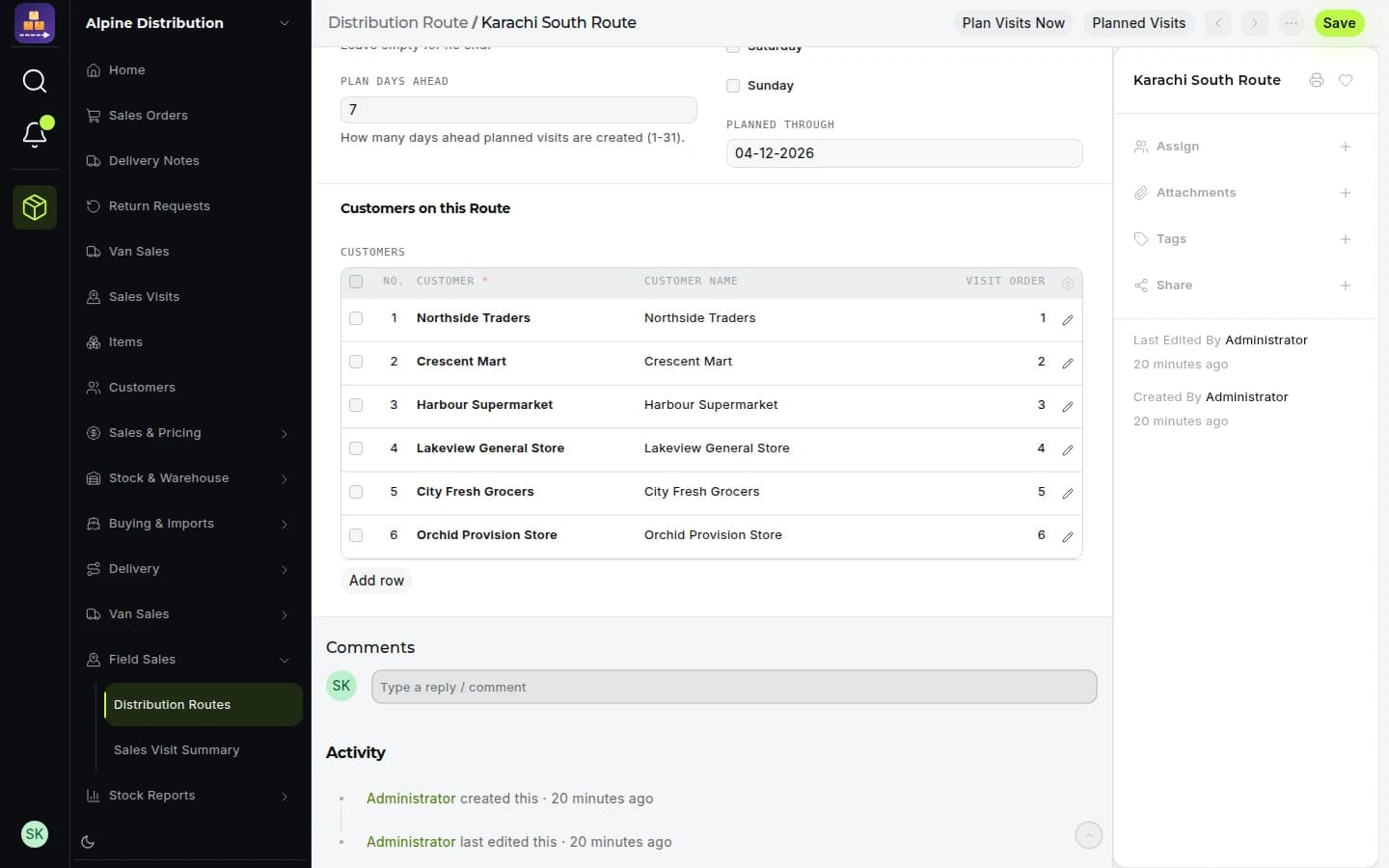
Routes and beats
An ordered list of customers on a weekly, fortnightly or monthly schedule. Visits are planned several days ahead for you.
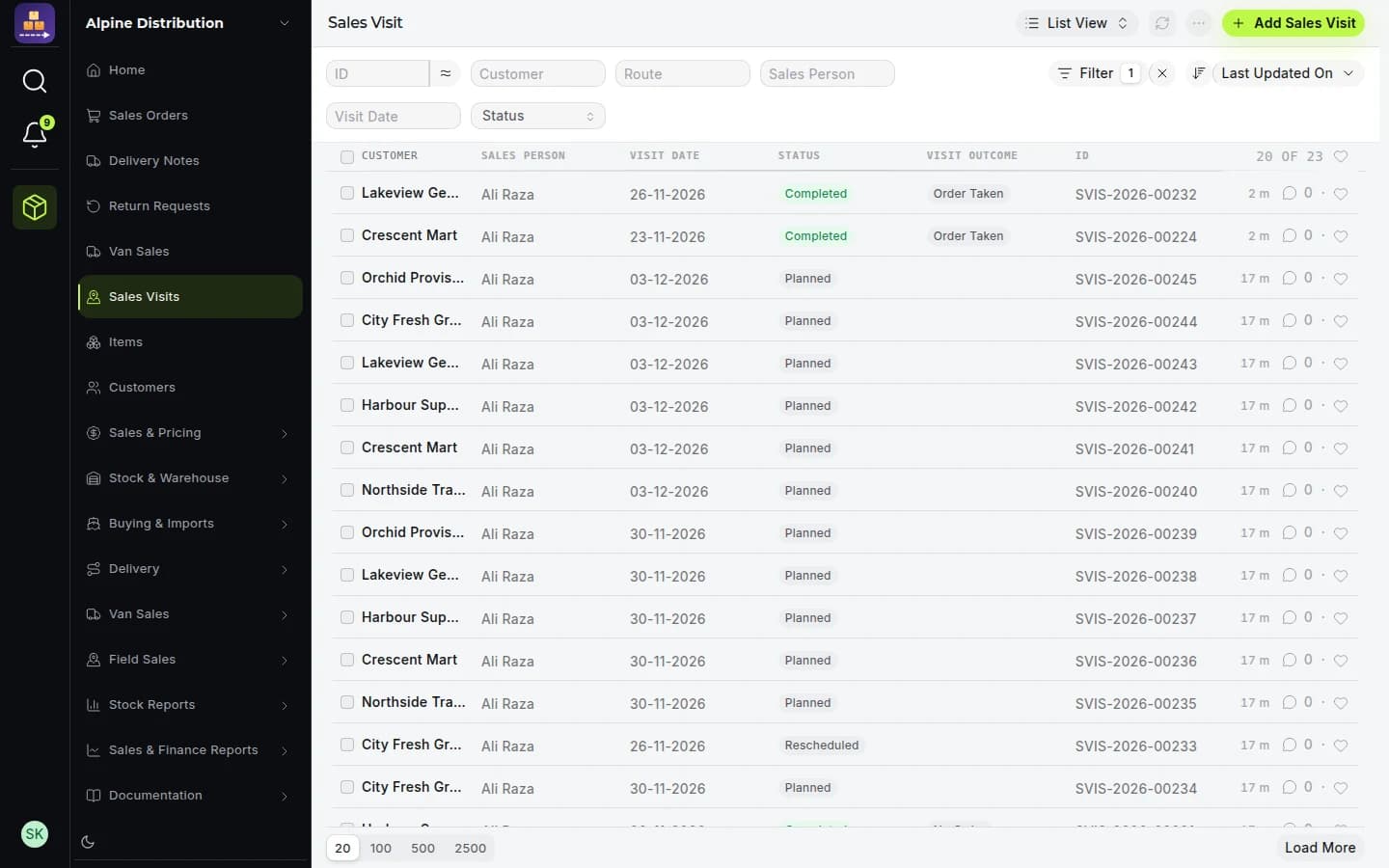
Sales visits
Check in, record the outcome (order taken, no order, shop closed, payment collected or follow-up) and check out.
Missed and rescheduled
Yesterday's unvisited stops are marked missed. Reschedule to a future date with a reason, and both visits stay linked.
Proof of delivery
Received by, signature, photo and failure reason on each stop. Cash collected must match a payment record for the same customer and amount.
Van sales
Van sales that close with a count, not a guess.
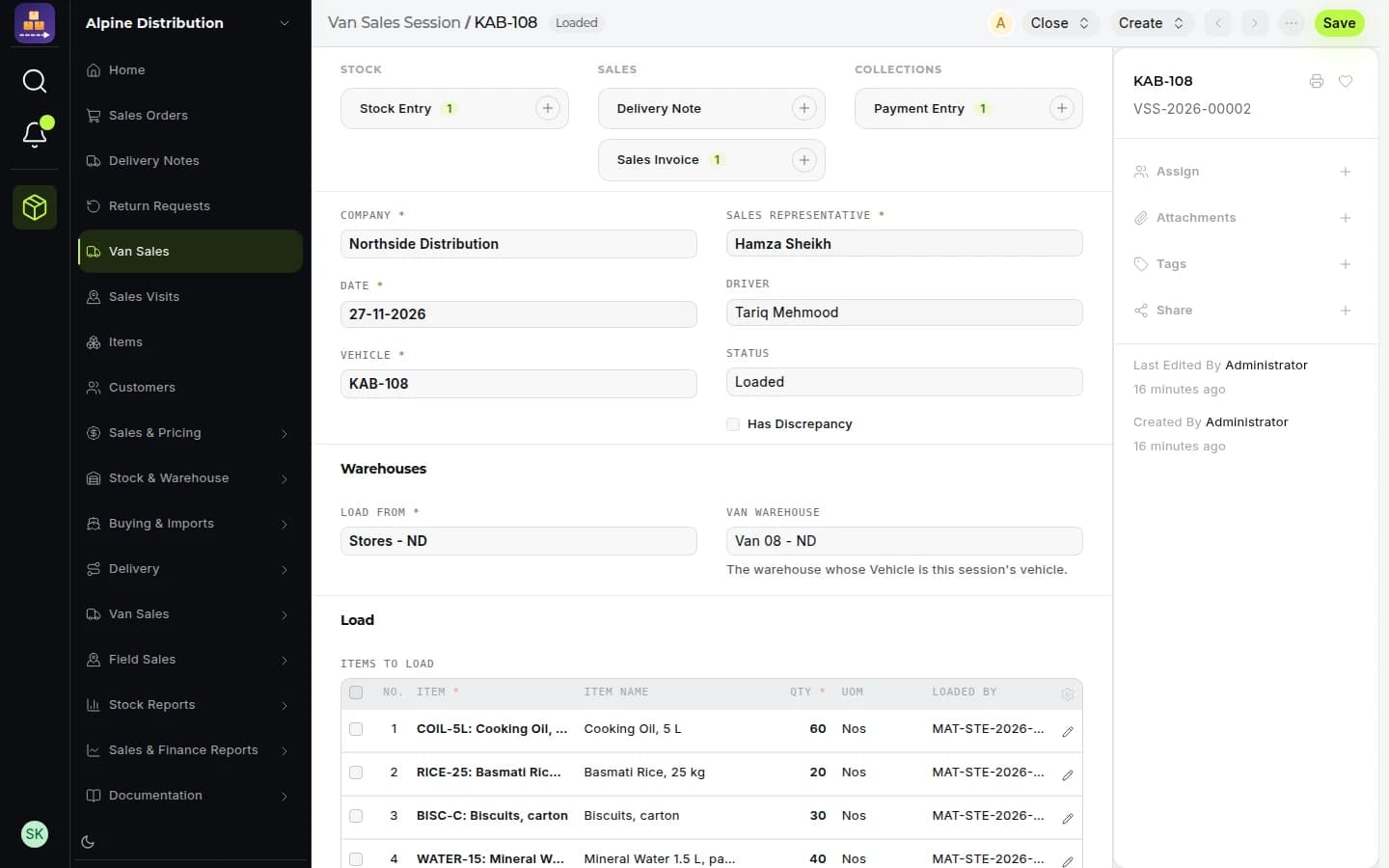
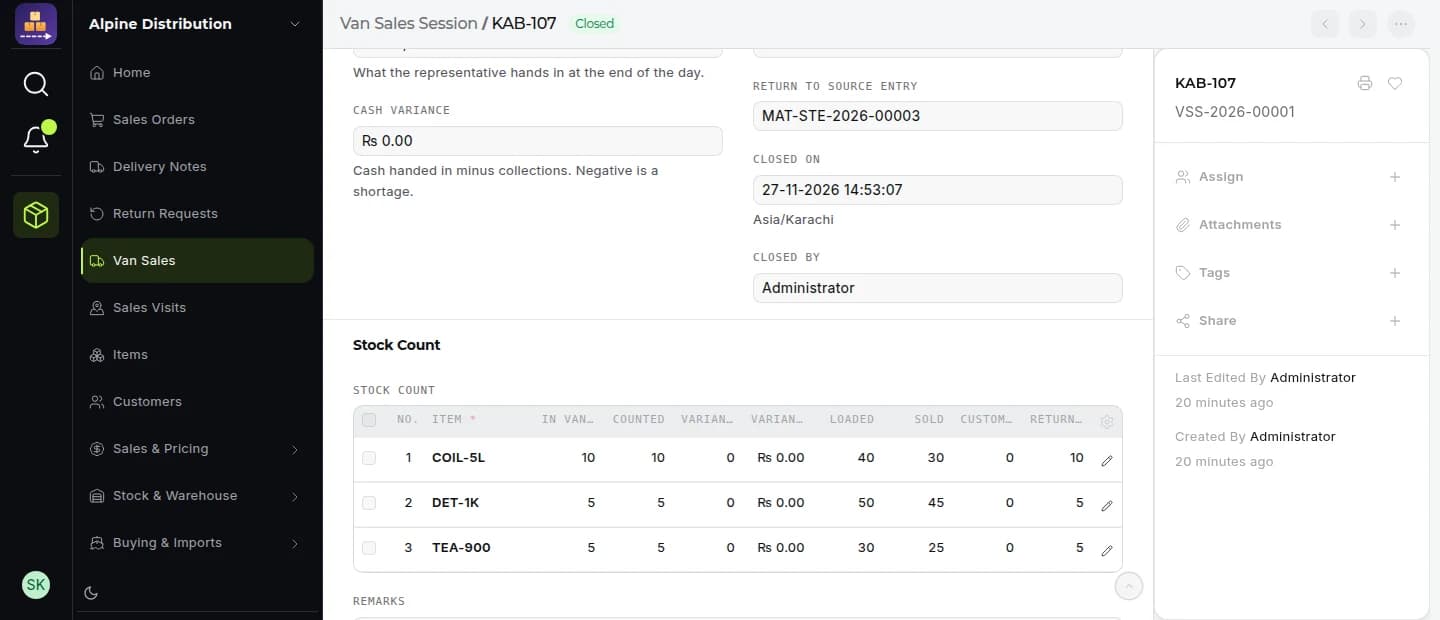
Each van is a warehouse. Load it, sell from it, collect cash, take returns, and close the day with a physical count. Differences are recorded, not hidden.
- The van's stock is a normal warehouse, with no parallel ledger
- Stock variance, cash variance and unrecorded movements are reported
- A closed session and its documents are locked
- Corrections are new documents, never edits
- 1
Plan
Open a session for a vehicle, a sales person and a driver. One open session per vehicle.
- 2
Load
Move stock from the store to the van. Top up while the session is open.
- 3
Sell and collect
Raise invoices or deliveries, record payments and take returns, all against the van's stock.
- 4
Reconcile
Count what is left and enter the cash handed in. Closing returns stock and records every variance.
Returns and claims
Returns are reviewed before stock or credit moves.
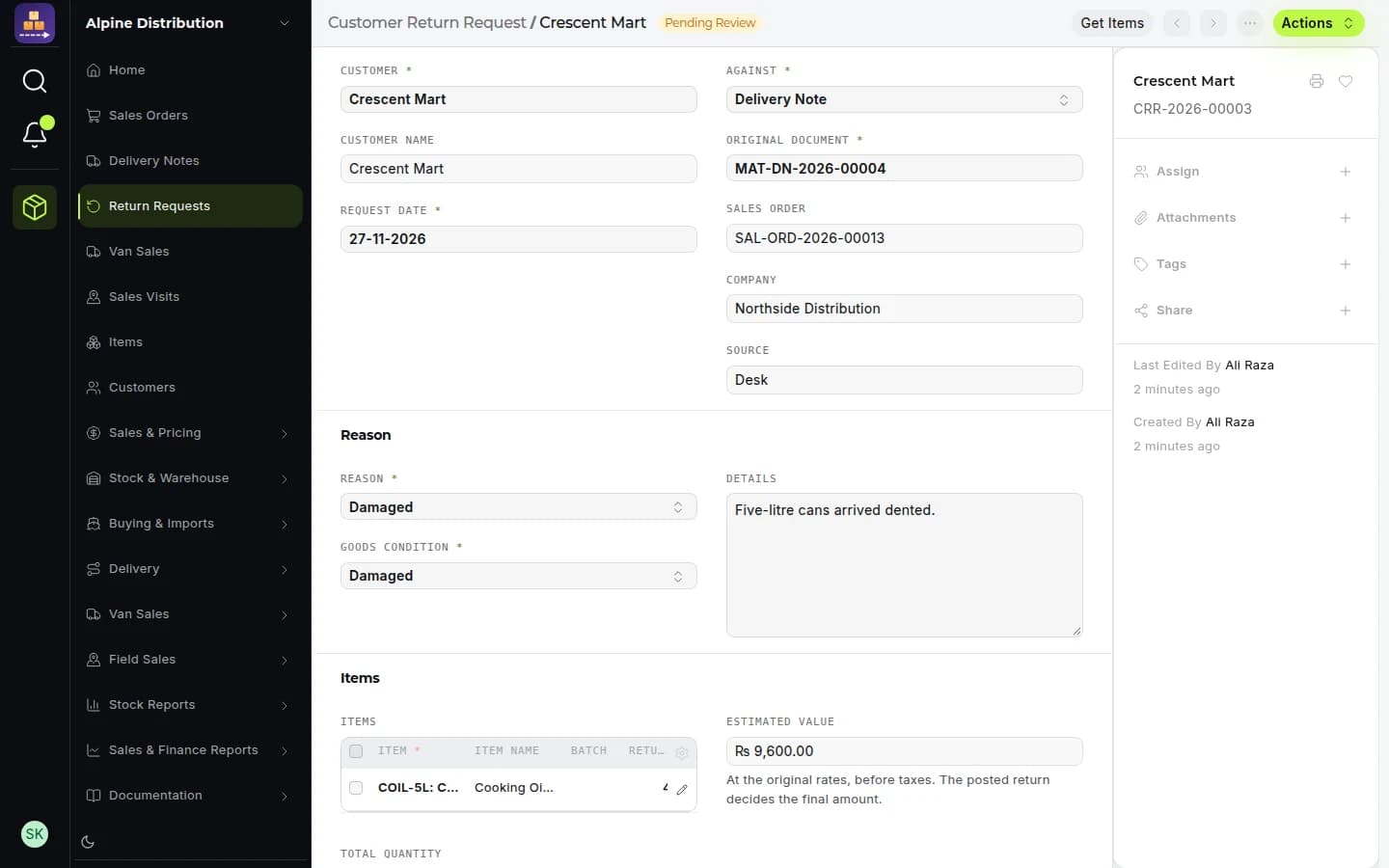
A request is raised against the delivery or invoice it came from. Nothing posts until a manager has decided and staff have checked the goods.
- 1
Request
Raised by staff or by the customer on the portal, against a delivered or billed document.
- 2
Review
A sales manager approves or rejects with a reason. Self-approval is blocked.
- 3
Draft return
Approval creates a draft return limited to the approved lines and quantities.
- 4
Posted
Staff check the goods and the warehouse, then post. Stock and accounts change only now.
- The returnable quantity is what was sold, less posted returns and other open requests
- Damaged and expired goods go to a returns or quarantine warehouse
- Quarantine stock cannot be sold without a normal transfer
Buying and landed cost
Know what your stock really cost.
Buy, receive and pay suppliers the usual way. For imports, add freight, insurance and customs to the receipt and spread them across the goods, so the stock value and your accounts include them.
- Purchase order, receipt, invoice and payment
- Landed costs shared by quantity or by value
- Stock value rises and the books stay balanced
- An alert 30 days before a batch with stock expires
- Slow-moving and dead stock by days since last sale
Reports and dashboards
Each role sees the numbers it works with.
Reports read your live records. Dashboards are filtered by role, so a driver, a manager and an accountant each open something relevant.
Reports
- Customer statement
- Planned visits
- Sales visit outcomes
- Sales visit summary
- Delivery performance
- Van stock
- Van sales movements
- Van collections
- Van end of day
- Van discrepancies
- Slow-moving and dead stock
Dashboards
- Management
- Approvals
- Sales
- Purchase
- Warehouse
- Delivery
- Accounts
- Field sales
- Van sales
One system
Part of your ERP, not a system beside it.
Every van load, delivery, return and payment is an ordinary record in AlpineERP. The distribution tools add the workflow around them.
- One set of customers, items, prices and stock
- Each sale, return and payment posts to your accounts when it happens
- Role-based access, with each role limited to what it needs
- Guided onboarding, form tours and optional sample data to learn on
Questions
Distribution software questions.
Who is this for?
Wholesalers, distributors, dealers, importers and trading companies that sell to other businesses, in food and beverage, FMCG, pharmaceutical, electronics, building materials and general merchandise.
Can my customers place orders themselves?
Yes. Customers sign in to a private portal, see their own prices and whether items are in stock, and place orders. Each order is priced again on the server and waits for your approval.
Can each customer have a different price?
Yes. A customer-specific price, with start and end dates, applies on every order from your team and from the portal. Volume, customer-group and free-goods offers are supported, and a negotiated price is not discounted again.
How do van sales work?
Each van has its own warehouse. You load it from the store, sell and collect from it, then close the day with a stock count and the cash handed in. Differences are recorded and reported.
Does it track vehicles by GPS or plan the best route?
No. A route is an ordered list of customers on a schedule, and visits are planned for you. GPS tracking and route optimisation are not part of it.
Can customers pay online through the portal?
Not yet. Your staff record payments and advances, and the customer sees them on the portal with their balance and statement.
Does it handle several companies or branches?
It is built for one company with as many warehouses as you need, including vans. Multi-company and branch management are not part of it.
Does it handle imports and customs?
It handles the cost side: freight, insurance and customs can be added to a receipt and shared across the goods. It is not a customs-clearance or freight-forwarding tool.
What does it cost?
Apps are not priced separately. See the plans for what each one includes, all with unlimited users.
Is there a free trial?
Yes, 7 days, with no card to start.
See how your distribution business would run.
Start the free trial and take an order from quote to payment on your own site. No card to start.